.svg)
.svg)

When The Precious Metals Market Went on Tilt
Why January’s silver crash wasn’t a fundamentals story — and what it revealed about leverage, liquidity, and the architecture of modern markets.
Table of contents
Welcome to MacroMashup
MacroMashup is a weekly briefing for investors who want to understand what’s actually moving markets — not just the narratives layered on top after the fact.
We focus on:
- Constraints, not forecasts
- Market structure, not vibes
- Capital flows, leverage, and incentives — where things actually break
If you’re tired of hindsight explanations and want a clearer lens on how modern markets behave under stress, you’re in the right place.
👉 Subscribe to MacroMashup to get the full weekly briefing, deep dives, and private audio straight to your inbox.
When the Trade Breaks Before the Thesis Does
On January 30, 2026, the precious metals market didn’t “correct.”
It broke.
Gold fell 11.4% in a single session, closing near $4,745.
Silver collapsed 31.4% to $78.53 — its worst single-day decline since March 1980. Just 24 hours earlier, silver had traded above $121, and gold had pushed past $5,600.
Depending on how you count derivatives exposure, between $5.9 trillion and $7 trillion in notional value evaporated in less than a day.
And yet — almost nothing fundamental changed.
Fiscal deficits didn’t shrink.
Central bank gold buying didn’t reverse.
U.S. public debt didn’t magically fall below $36 trillion.
The debasement thesis that had driven gold up 24% in January and silver up more than 60% was still intact.
So what happened?
The answer matters, because this wasn’t a warning about precious metals.
It was a warning about how modern markets fail.
Catalyst ≠ Cause
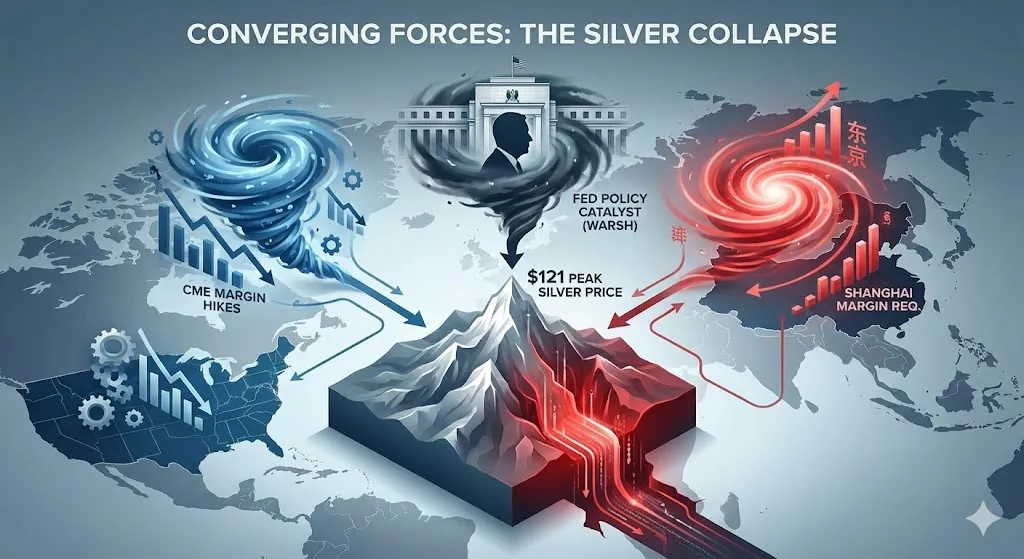
Kevin Warsh’s nomination chatter as a potential Fed chair replacement acted as the spark, not the fire.
The headlines framed the crash as a sudden hawkish pivot — a return to “monetary discipline.” But Warsh hadn’t set policy. He wasn’t confirmed. And his own history suggests flexibility when politics demand it.
What the Warsh news actually did was something far more dangerous:
It flipped the narrative at the exact moment positioning was most fragile.
Large candles on the way up create large candles on the way down — especially when leverage is involved.
The Hidden Fault Line: Leverage
The real story was mechanical.
Between late December and January 29, three separate margin shocks hit the global metals complex:
- Shanghai Gold Exchange raised margin requirements and cash per lot, forcing early liquidation among highly leveraged Chinese retail traders.
- Chinese securities regulators tightened equity margin rules, forcing brokers to sell precious metals being used as collateral.
- CME raised maintenance margins aggressively — silver margins for some traders jumped as high as 165%.
For a trader holding 100 silver contracts, that meant finding $1.2 million in cash immediately — or selling.
Most sold.
Not because they changed their minds.
Because the math stopped working.
Paper Burns, Physical Holds
Here’s where the story gets unintuitive.
While futures markets were imploding, ETF inflows were surging:
- $4.39 billion into precious-metals ETFs in January alone
- Eight consecutive months of inflows
- Long-only, largely unlevered buyers stepping in
GLD traded at a rare discount to NAV, and SLV reportedly fell to nearly -19% — a sign that forced paper liquidation temporarily overwhelmed physical demand.
This wasn’t a collapse in conviction.
It was a collapse in positioning architecture.
Why This Matters
What broke in January wasn’t silver.
It was the illusion that parabolic moves powered by leverage can unwind gently.
In the full Deep Dive, we break down:
- How margin spirals actually propagate across continents
- Why ETF–futures dislocations happen during stress
- Who likely got crushed — and who quietly absorbed supply
- Why parabolic trades always end this way
- And why the debasement thesis was interrupted, not invalidated
If you want to understand how markets fail before narratives catch up, the rest of this analysis is where the real signal is.
👉 Continue reading below to access the full Deep Dive.
Table of contents
Author
.avif)
BOOK A CALL
READY TO TAKE ACTION ON YOUR ENERGY PROJECT? BOOK A COMPLIMENTARY, ZERO-OBLIGATION CONSULTATION TO SEE HOW WE CAN HELP YOU.
Book Here.svg)
.svg)

