.svg)
.svg)

Subscribe to MacroMashup News
The Age of Noise in National Security Tech
Warfare is changing in real time.
Not in the abstract. Not in white papers. In Ukraine, in supply chains, in the pace of iteration—where cheap drones can threaten billion-dollar platforms, and where the next competitive edge is measured in weeks, not programs.
And in a world where complexity sells and clarity is rare, truth becomes a strategic asset.
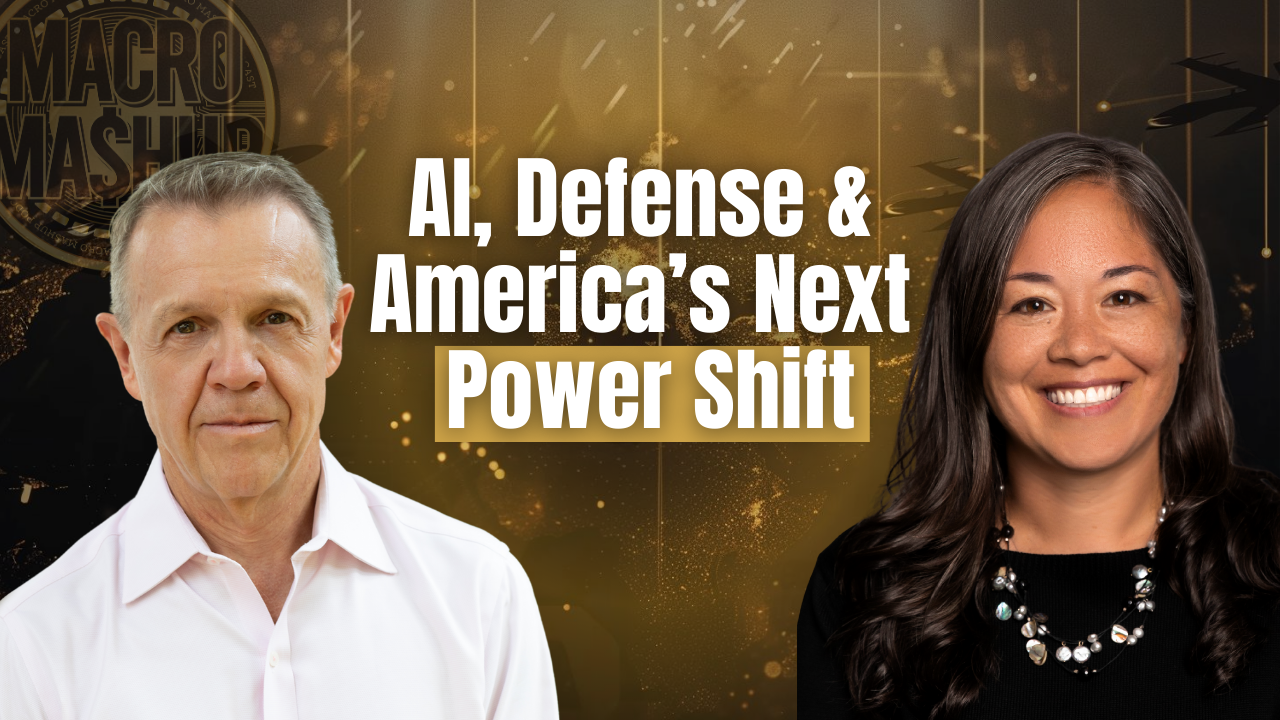
On Episode 8 of Macro Mashup Podcast, host Neil Winward sits down with Liz Young McNally—combat veteran, former Deputy Director for Commercial Operations at Defense Innovation Unit, former partner at McKinsey & Company, and former Co-CEO of Schmidt Futures—to map the new fault lines of American competitiveness.
The thread running through the conversation is simple:
The future of national power will be decided by the speed of adoption—where commercial technology, public demand signals, and capital markets collide.
Three key takeaways
- The inflection point isn’t one thing—it’s geopolitics plus AI.
Liz Young McNally frames this moment as two shocks hitting at once: a geopolitical reset and a technological acceleration driven by AI. The result is a shift in how nations think about deterrence, supply chains, and what they must be able to produce themselves. - Defense innovation has moved from government labs to private capital—now the Pentagon is racing to catch up.
Decades ago, the biggest R&D engine ran through government budgets. Today, innovation is often venture-funded first—then adapted for defense. That inversion is why organizations like Defense Innovation Unit exist: to shorten the gap between commercial capability and military adoption. - Venture is necessary—but not sufficient.
As the conversation turns to reshoring, minerals, manufacturing capacity, and capital intensity, the takeaway sharpens: some missions need larger pools of capital, stronger demand signals, and policy continuity. The opportunity is real—but so are the constraints.
The new battlefield is speed
“Warfare is changing,” Liz Young McNally says plainly—pointing to shifting tactics and the rapid diffusion of low-cost capability.
A decade ago, the strategic moat was often scale: platforms, fleets, and long procurement cycles.
Now the moat is increasingly adaptation:
- autonomous systems
- AI-enabled targeting and sensing
- cheap drones that compress the cost curve
- faster cycles from prototype → deployment → iteration
The uncomfortable implication is that legacy advantage can become legacy exposure.
From government-led innovation to private-led innovation—and back again
One of the most important parts of this episode is the historical reversal:
If you go back multiple decades, much of America’s cutting-edge innovation was driven by government-funded defense R&D. Today, a growing share of frontier capability is built with private capital first—often for commercial markets—and only later adapted for national security use.
That change triggered a new mandate inside the Defense Innovation Unit era:
Make the Department of Defense easier to work with.
Not as a slogan—structurally:
- faster contracting pathways
- acquisition reform
- clearer demand signals
- “commercial best practices” applied to defense adoption
Liz makes a key point that matters to operators and investors alike: this shift is unusually bipartisan—rare alignment in a noisy political cycle.
The real constraint is industrial capacity
A theme that surfaces repeatedly is not just “new tech,” but the physical world underneath it:
- manufacturing capacity
- supply chain resilience
- strategic minerals
- energy inputs
- the ability to scale production fast enough to matter
When a nation’s inventory depletes faster than it can replenish—and replenishment relies on constrained inputs—the conversation stops being theoretical.
This is where the episode becomes a macro lesson:
Power is not only about what you can invent.
It’s about what you can produce—reliably, at scale, under pressure.
Industrial policy is back—because it has to be
The conversation touches the reality that the U.S. is already moving deeper into “industrial policy,” whether we call it that or not—through major policy tools and capital deployment, including:
- Office of Strategic Capital style financing approaches
- large-scale incentives (e.g., Inflation Reduction Act, CHIPS and Science Act)
- continued relevance of innovation engines like DARPA
- reform efforts through the National Defense Authorization Act
Liz’s stance is measured:
- government involvement is required in areas the market won’t rebuild on its own
- the risk is always incentives, continuity, and unintended consequences
- structure matters: deals must be designed to avoid dependency and misallocation
In other words: do it where there is no alternative—and do it with discipline.
The public–private partnership isn’t optional anymore
The episode lands on a modern reality: the boundary between commercial capability and national security capability is thinner than ever.
A single commercial platform can become strategic infrastructure. A single supply chain decision can become a national security exposure.
And when leaders like Jamie Dimon publicly commit to national security priorities, it signals what the market is slowly admitting:
Government is back as a major actor in shaping economic outcomes—and CEOs can’t pretend otherwise.
Liz frames the requirement for the next decade clearly: we need more people who can translate across both worlds—public and private—who assume positive intent, align incentives, and understand what a “real” demand signal looks like.
Leadership: the through-line from the Army to the buy-side
One of the most resonant parts of the episode is Liz’s leadership filter—built in the U.S. Army and sharpened across consulting and national security tech:
- It’s all about people. Leadership is servant leadership.
- You won’t be the expert. Especially early. Your job is to draw out the team.
- Trust is earned through care and hard decisions. Not through authority.
She also attributes her “cross-aisle” posture to the oath-first culture of military service—protecting institutions, not parties.
That matters because the buy-side version of this work will demand a new kind of discipline:
You will have to filter noise, ignore performative politics, and stay anchored to incentives, capability, and outcomes.
An investor’s filter for defense tech
Liz’s advice to anyone investing in defense technology is simple—and difficult:
Do your homework.
Understand the government as a customer:
- what procurement really looks like
- what counts as a demand signal (and what doesn’t)
- why timelines break
- where capital intensity changes the game
The opportunity is real—contracts are growing, and commercial-first defense players are increasingly winning meaningful scale.
The open question is speed: how fast the budget truly shifts—and how quickly exits mature—relative to the hype cycle.
Final thoughts
- The future belongs to fast adoption, not perfect plans.
- Industrial capacity is strategy.
- AI accelerates capability—but it doesn’t remove constraints.
- Trust, incentives, and execution still decide outcomes.
🎧 Listen to the full conversation
Watch or listen to Episode 8 of Macro Mashup Podcast featuring Liz Young McNally:
→ YouTube | Spotify | Apple Podcasts | Amazon Music
Liz Young McNalley_EP_ 08
[00:00:00]
Warfare is changing. We are seeing this, whether it is in Ukraine or in many other places, and we have to be prepared. The thousand-pound gorilla in the room is AI, the advancements in AI, the applications of AI, and just how quickly technology is changing. We actually do not have the wherewithal, and there is obviously some underlying, unstated, and definitely classified suggestion that we have some sort of super weapons in the background that we have not told anybody about.
[00:00:32]
If you go back multiple decades, almost all of the real innovation happening in the US was driven by government and defense R&D budgets. In particular, there is now huge growth in venture-backed companies using commercial best practices to build defense applications. Everything from munitions to autonomous vehicles and autonomous ships. Fascinating things such as applying small drones to fly into buildings so that when the armed forces are considering actually going into that building, they know exactly what is on the inside.
[00:01:05]
I remember once you were giving a talk and the question emerged, how do you feel about your kids serving in the Army? And you said, well, if anything, I would be more worried if they did not want to.
[00:01:20]
Welcome to the MacroMashup Podcast. I am your host, Neil Winward. This podcast is sponsored by Dakota Ridge Capital, your energy investments partner, helping developers partner with family offices, banks, and corporations to make smart clean energy deals and maximize government tax incentives.
[00:01:40]
MacroMashup.
[00:01:42]
Liz Young McNally today on MacroMashup. Liz is joining us. She is a combat veteran, a strategist, and a tech leader shaping innovation at the heart of US national security. Until recently, stop me if I get this wrong, you were the Deputy Director for Commercial Operations at the Defense Innovation Unit, also known as DIU.
[00:02:10]
That unit’s function was to help bridge Silicon Valley and the Pentagon to strengthen America’s technological edge. Before that, you were at Schmidt Futures. Before that, a partner at McKinsey. And before that, you were an officer in the US Army.
[00:02:35]
We are going to explore technology, leadership, and strategy, and how they are redefining economic power, what it means for investors, and for America’s long-term competitiveness.
[00:03:00]
As you look across all these areas, what are the biggest inflection points shaping America’s competitiveness in a more multipolar world?
[00:03:12]
Yeah, absolutely. First of all, thanks so much for having me on. I am really excited to be here. I think we truly are at an inflection point. Two major forces are driving it: the geopolitical moment and the technological moment.
[00:03:38]
On the geopolitical side, warfare is changing. We see this in Ukraine and elsewhere. The US and Europe are rethinking deterrence, readiness, and self-reliance, especially around manufacturing and supply chains.
[00:04:10]
On the technology side, AI is the thousand-pound gorilla. The pace of advancement is staggering. Where we were a year ago versus today versus a year from now is extraordinary.
[00:04:40]
These forces are converging. One reason the US cannot play the same role it once did is that we have depleted key inventories and lack domestic manufacturing capacity for certain systems, including rare-earth-dependent components.
[00:05:20]
There is also an unstated assumption that the US has advanced capabilities in reserve. But that does not replace industrial capacity.
[00:05:45]
From your time at DIU, how does this look inside the Department of Defense?
[00:05:55]
If we roll the clock back about ten years, there was a realization that commercial technology was advancing faster than defense adoption. Innovation shifted from government R&D to private capital, and the Pentagon struggled to keep up.
[00:06:30]
Over the past decade, that has changed. DIU and others helped accelerate adoption of dual-use technologies.
[00:07:00]
Today, venture-backed companies are building defense capabilities using commercial best practices, from munitions to autonomous vehicles and ships.
[00:07:35]
There is also recognition that acquisition and engagement models must change. This effort is unusually bipartisan and has accelerated in recent years.
[00:08:10]
The National Defense Authorization Act furthers these reforms and enables faster integration of commercial technology.
[00:08:35]
You mentioned drones mapping buildings before troops enter. Did you see many innovations like that at DIU?
[00:08:50]
Yes. DIU worked across seven technology areas, including AI and autonomy, energy, cyber, space, human systems, advanced manufacturing, and emerging technologies like hypersonics and quantum.
[00:09:30]
Each area has commercially driven technologies that directly improve outcomes for the warfighter.
[00:09:55]
One key intersection is private infrastructure like Starlink, which has both civilian and military value.
[00:10:30]
This brings us to capital markets, materials, energy, and manufacturing. Software alone is not enough. Physical infrastructure and supply chains matter.
[00:11:05]
Government has begun making strategic equity and loan investments to rebuild domestic capacity.
[00:11:40]
Venture capital is necessary but not sufficient, especially for capital-intensive sectors.
[00:12:10]
This raises questions about industrial policy, incentives, and execution risk.
[00:12:45]
Government involvement has always existed. In some areas, it is unavoidable. The key risk is incentive alignment and policy whiplash.
[00:13:30]
As you think about moving to the buy side, how do you see your role?
[00:13:45]
This is a critical moment. Investors who understand government as a customer will be essential to making this ecosystem work.
[00:14:20]
Ethics and leadership matter. My background at West Point and in the Army instilled a strong sense of duty and service.
[00:15:00]
Veterans bring that mindset into investing, industry, and government.
[00:15:20]
Looking back, what lessons stand out from your career?
[00:15:30]
From the Army, servant leadership. Take care of people and the mission follows.
[00:16:05]
As a platoon leader, you learn to lead people more experienced than you and rely on their expertise.
[00:16:40]
Those lessons carried through McKinsey, Schmidt Futures, and DIU.
[00:17:10]
Was there a defining leadership moment?
[00:17:20]
It was more of a process. People need to trust that you have their best interests at heart and can make hard decisions thoughtfully.
[00:18:00]
There is a strong pipeline from the military to McKinsey. Do you still draw on that network?
[00:18:15]
Yes. Both institutions have strong cultures and shape leaders deeply.
[00:18:50]
You once said you would worry if your kids did not want to serve.
[00:19:00]
Service matters. It does not have to be the military, but using your talents in service of others is important.
[00:19:40]
Are you optimistic about public-private partnerships?
[00:19:50]
Yes. The current moment has forced both sides to recognize their interdependence.
[00:20:30]
We need leaders who can bridge both worlds and align incentives.
[00:21:00]
What advice would you give a new defense investor?
[00:21:10]
Do your homework and filter the noise. Understand what real government demand looks like.
[00:21:50]
It is not easy, but the opportunity is real.
[00:22:10]
Are the returns there?
[00:22:15]
Yes. Contract sizes are growing, and capital is flowing, but execution matters.
[00:22:45]
This ecosystem will continue to expand across space, defense, and infrastructure.
[00:23:20]
It is a complex world, but an important one.
[00:23:35]
Thank you for joining us, Liz.
[00:23:40]
Thank you for having me.
[00:23:45]
Thanks for being on MacroMashup. See you soon.
[00:23:50]
Bye-bye.

.svg)
.svg)





.svg)
.svg)

