
Oops! Something went wrong while submitting the form.
The U.S. housing market is frozen not by prices, but by mortgage lock-in. Millions of homeowners are financially trapped by sub-4% mortgages, unable to move without forfeiting hundreds of thousands of dollars in purchasing power. This MacroMashup deep dive introduces residential defeasance — a long-standing commercial real estate tool — as a potential solution to unlock “ghost assets,” restore labor mobility, flood the market with inventory, and recapitalize the American middle class without rate cuts or taxpayer stimulus.
Welcome to MacroMashup — where we go past headlines and into the mechanics driving markets, policy, and capital flows.
If you care about why the economy behaves the way it does — not just what happened this week — you’re in the right place.
This week’s deep dive is exactly the kind of structural analysis MacroMashup is built for.
Subscribers receive:
• Weekly premium macro deep dives
• Structural frameworks for policy and capital shifts
• Early identification of second-order investment winners
• Clear explanations of complex financial plumbing
The economy is changing fastest in the places few people understand.
Before we get to housing, let’s take a quick look at where we ended 2025.
2025 Macro Recap: Systems Over Narratives
The final numbers for 2025 are in, and the message is clear: Embrace systems and hard analysis; save the headlines for entertainment. This year proved that market narratives are often just noise designed to distract you from the structural trends that move the needle.
The “Bear Porn” Fallacy
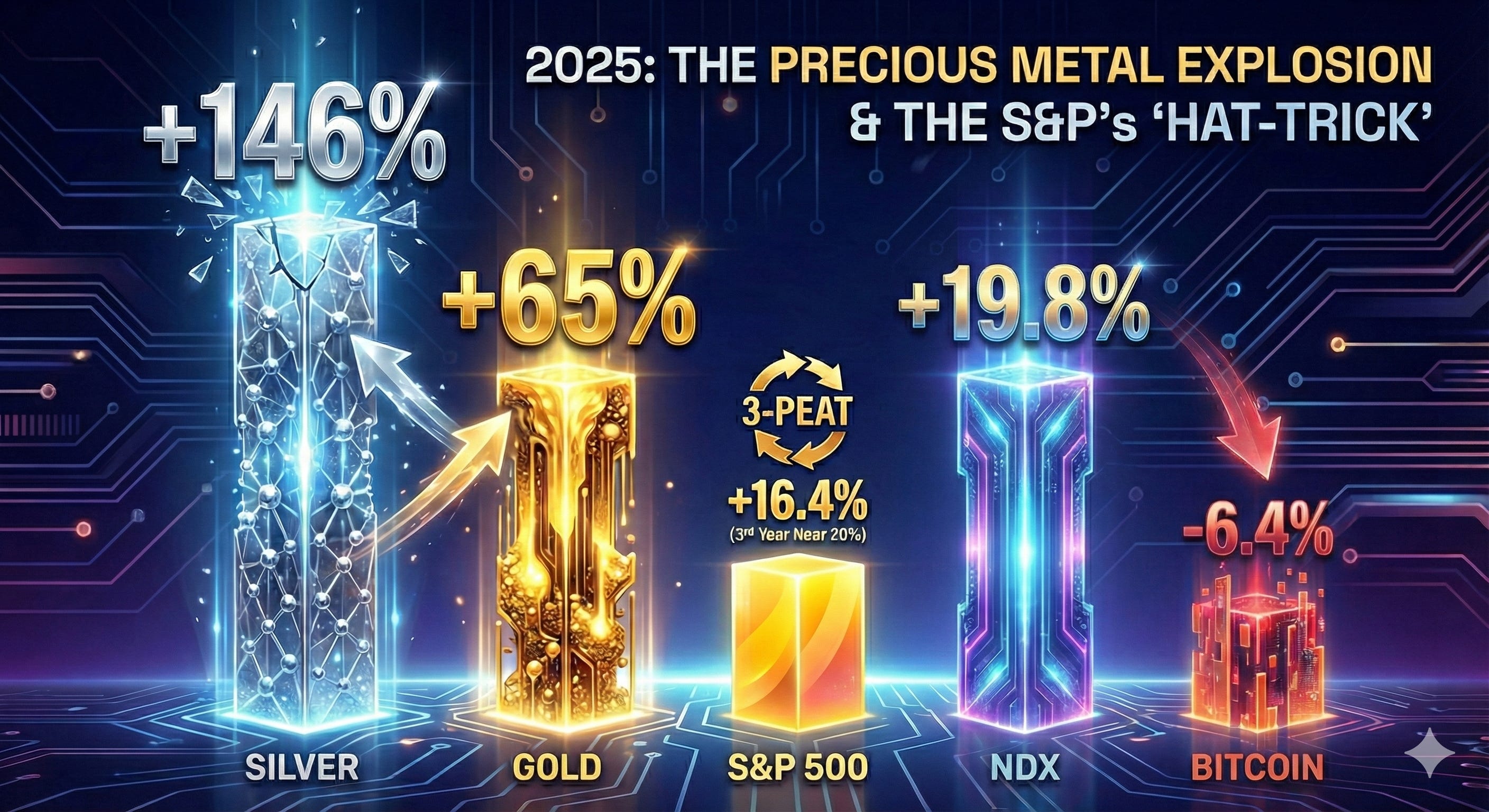
If you succumbed to the “recession is imminent” bear porn narratives in April and stayed on the sidelines, you missed another solid year for equities. The S&P 500 delivered a 16.4% return, marking a rare “hat-trick” of three consecutive years with near-20% or better returns (24.2% in 2023 and 23.3% in 2024). Meanwhile, the tech-heavy NDX outpaced it with a 20.5% gain.
Hard Assets, Hard Data
Those who ignored the macro implications of persistent deficits and geopolitical friction missed a historic uptrend in precious metals. Silver was the champion of 2025, skyrocketing ~144%, while Gold finished up 65%—its strongest annual performance in decades. These weren’t speculative bets; they were systematic responses to a structural supply-demand imbalance and a global “debasement trade”.
The Bitcoin Reality Check
Finally, if you believed the narrative that 2025 was the year Bitcoin would accelerate into a new dimension, the charts taught you a difficult lesson. Despite a brief, high-octane run to all-time highs near $126,000 in October, the leading digital asset decoupled from the “everything rally” to end the year with a 6.4% decline. This highlights the danger of relying on “digital gold” narratives when the system itself—liquidity, leverage, and positioning—signals a different path.
What’s Going on with Housing?
The U.S. housing market looks strangely resilient.
Prices are still high.
Mortgage defaults are low.
Homeowners appear “wealthy” on paper.
And yet… almost nobody is moving.
This is usually explained as an affordability problem or blamed on “higher rates.” That explanation is convenient — and wrong.
What’s actually happening is more uncomfortable:
The American housing market is frozen because moving destroys private wealth.
Not a little.
Six figures.
Hidden inside millions of sub-4% mortgages is a financial asset most homeowners don’t know they own — and the moment they sell their home, that asset vanishes.
That disappearing value doesn’t show up in GDP.
It doesn’t show up in housing statistics.
But it quietly dictates behavior.
People stay put.
Jobs go unfilled.
Inventory dries up.
And policymakers keep pushing the wrong levers.
Here’s the contrarian part:
The housing crisis is not about prices, supply, or demand.
It’s about the forced destruction of a valuable financial contract.
This week on MacroMashup, we explore a question almost no one is asking:
What if a mortgage isn’t just debt — but an asset?
And what if the solution to the housing freeze already exists, hidden in plain sight, quietly used by professionals — just not households?
What We’re Diving Into This Week
This is where the overview ends — and the real work begins.
In the second half of this piece, we break down:
• Why millions of homeowners are sitting on a six-figure “ghost asset”
• The math behind why selling destroys purchasing power
• How commercial real estate already handles this problem
• Why lenders might actually prefer an alternative structure
• How this could restart housing mobility without stimulus or rate cuts
• Why this reframes the entire housing-policy debate
This isn’t a housing take.
It’s a capital-plumbing problem hiding inside plain English.
If you want the full argument — and the mechanics behind it — this is where you continue.
Neil Winward is the founding partner of Dakota Ridge Captial, helping investors, developers, banks, non-profits, and family offices unlock massive tax savings - on average of 7%- 10% - via clean energy investments by fully leveraging U.S. government incentives such the Inflation Reduction Act.
BOOK A CALL
READY TO TAKE ACTION ON YOUR ENERGY PROJECT? BOOK A COMPLIMENTARY, ZERO-OBLIGATION CONSULTATION TO SEE HOW WE CAN HELP YOU.
The Yen Carry Wobbles, China Steps Back, and Sovereign Duration Stops Feeling Frictionless
Welcome to MacroMashup — where we track the plumbing beneath the headlines.
We focus on funding markets, sovereign balance sheets, and the structural flows that determine which assets become collateral — and which become narratives.
If you’re new here, subscribe for weekly macro breakdowns that connect policy, capital flows, and portfolio positioning — before the consequences become obvious.
Calm Surface, Cracked Foundations
This week’s macro tape looks calm on the surface.
The Fed is in blackout mode, parked at 3.50–3.75%. No new dot plot. No press conference shock. Just a steady drip of inflation and labor data for markets to over-interpret.
There is good and bad in the delayed non-farm payrolls numbers:
Good enough to push back on imminent recession/hard-landing narratives (headline beat, unemployment down, participation up).
Not good enough to erase the story of a materially cooled labor market once you incorporate the 2025 revisions (-900k) and very narrow sector leadership.
For markets: bullish for near-term risk sentiment vs "jobs scare" scenarios, but mildly bearish for front-end duration versus hopes of rapid cuts, with a tilt toward a slow-grind softening rather than a cliff.
January is a volatile month, and not that reliable.
Equities rotate instead of breaking, though the AI scare continues to create anxiety at the white-collar end. The market is beginning to try picking winners and losers.
The 10-year chops around.
Nobody says they’re de-risking — but positioning keeps getting tighter.
Then geopolitics delivers peak 2026 energy: a political standoff over a literal bridge.
The Gordie Howe International Bridge — one of the most important trade crossings between Detroit and Windsor — is now a bargaining chip. The White House is threatening to block its opening unless the U.S. gets a “better deal,” up to and including revisiting permits.
When a concrete span becomes leverage, you’re being reminded of something bigger:
Critical infrastructure is no longer sacred.
It’s collateral.
Under the surface, the real story isn’t about bridges.
It’s about who funds what — and who stops funding it.
In this week’s Deep Dive for paid readers, we examine:
Why the yen carry trade just lost its training wheels
Why Japan’s bond market is no longer “sleepy”
Why China is quietly telling banks to temper Treasury exposure
And what happens when sovereign duration stops feeling frictionless
Bitcoin bled lower this week, behaving less like digital gold and more like a liquidity-sensitive risk asset. Hard assets are beginning to diverge — some are collateral, some are narrative.
Markets price stories. Energy prices physics. MacroMashup cuts through hype, coal reality, policy, and capital flows.
Welcome to MacroMashup
A systems-level briefing on markets, energy, geopolitics, and capital flows.
MacroMashup is not a news recap.
We don’t chase headlines, hot takes, or moral theater. We focus on constraints — the physical, financial, and political limits that actually shape markets before narratives catch up.
Each edition connects:
Macro policy and market structure
Energy, infrastructure, and industrial reality
Capital flows across assets, regions, and regimes
The goal isn’t prediction.
It’s orientation — so you can see regime shifts forming while others are still arguing about stories.
If you’re new here, start with the free section below.
👉 Subscribe to MacroMashup to receive:
Weekly free macro briefings
Member-only deep dives into energy, policy, and capital allocation
Private audio notes framing how to read the week calmly
Paid members get the full analysis, charts, and portfolio-level implications.
Markets are trading stories. Energy is trading physics.
The Fed met this week with one objective: don’t spook anyone.
Policy remains nominally unchanged. The language is softer. Powell is stuck in the narrow corridor where inflation isn’t dead, growth isn’t dead — but political tolerance for pain very much is. The only thing reporters really wanted to talk about wasn’t policy at all. It was politics…
And, it was succession.
Rick Rieder at BlackRock is now widely seen as the front-runner to replace Powell, a signal that markets are already gaming the next regime rather than listening to the current one.
Equities keep floating higher for the same reason they’ve been floating all year: relative attractiveness. Compared to everything else on the menu, stocks still look like the least-ugly chaos hedge.
The real tell isn’t in equities.
It’s in shiny rocks.
Gold north of $5,000 and silver above $110 isn’t about CPI prints. It’s about trust.
Central banks keep accumulating quietly.
Retail is finally noticing.
And silver’s industrial role in AI, solar, and electrification is turning a “store of value” into a supply-chain bottleneck.
Meanwhile, Minnesota has become the unwilling focal point of America’s immigration psychodrama.
The killing of Alex Pretti — an ICU nurse and U.S. citizen — by federal immigration officers in Minneapolis detonated a narrative shift. After video evidence dismantled the initial “terrorist” framing, the administration pivoted fast: reviews announced, Tom Homan dispatched, language softened.
State officials are suing. Judges are weighing restraining orders. Even some Republicans are blinking at the optics.
Layer in South Korea slow-rolling U.S. investment commitments — and getting tariff threats in response — and you’re watching an administration try to be pro-market, pro-tariff, tough on immigration, and allergic to viral video all at once.
Then there’s industrial policy.
Washington just wrote another check into the rare-earths casino: up to $277 million in direct support, plus a potential $1.3 billion in additional backing for USA Rare Earth — in exchange for equity and warrants. Venture logic, sovereign balance sheet.
So where does that leave us?
Here’s the MacroMashup snapshot:
Macro regime: shifting from “central banks in charge” to “fiscal math in charge.” Bond markets are slowly realizing they’re financing deficits politics won’t fix.
Policy reality: the tightening narrative is over. De-facto gradual monetization is in. Structurally negative real rates remain the path of least resistance.
Asset implications:
Tailwinds for hard assets, energy, commodities, and durable cash-flow businesses
Bitcoin should benefit eventually — but hasn’t yet
Headwinds for long-duration paper claims dependent on stable real yields
Market behavior:
Mega-caps and Treasuries can levitate on flows and AI narratives
Breadth is improving beneath the Mag 7
Volatility shocks are becoming a feature, not a bug
Capital rotation: slow but real movement away from concentrated U.S. duration risk toward:
Energy and commodities
Geographically diversified real assets
Balance sheets built for financial repression, not perfection
That’s the surface.
Now let’s dig into where the energy story breaks down — and why the narrative no longer matches the operating system.
Unlock the Opportunities of the Inflation Reduction Act! Are you ready to stay ahead in today's shifting economic landscape? Our comprehensive white paper breaks down the Inflation Reduction Act and reveals the key benefits, incentives, and strategies your business needs to capitalize on. Learn how to optimize your financial planning, leverage tax credits, and position your company for sustainable growth.
Pre-order now to get the insights and actionable steps that can give your business a competitive edge.
New Version Release Date: 12/10/2024
Thank you! Your submission has been received!
Oops! Something went wrong while submitting the form.